
Acting on Impact Priorities
We follow a disciplined materiality assessment of identifying the issues critical to long-term value creation and stakeholder confidence. We utilise this lens to understand the intersection of our business with economic, environmental and societal expectations, and to prioritise areas that warrant strategic focus and governance attention.
The assessment follows a structured, data-driven approach anchored in global frameworks and guided by continuous engagement with internal and external stakeholders. Through this, we evaluate emerging risks, opportunities and impacts across our value chain and translate them into actionable priorities that guide strategy, resource allocation and transparent disclosures.
Assessing Priorities Through a Double Materiality Lens
We strengthened our approach through a comprehensive Double Materiality Analysis in FY 2024-25, aligned with GRI 2021 and ESRS General Disclosures.
The exercise evaluates two dimensions of significance: the effect of evolving issues on business performance, and the Company’s broader impact on people, the environment and society. The results form the foundation for priorities in FY 2025-26, shaping focus areas, guiding management oversight and sharpening the clarity of disclosures.
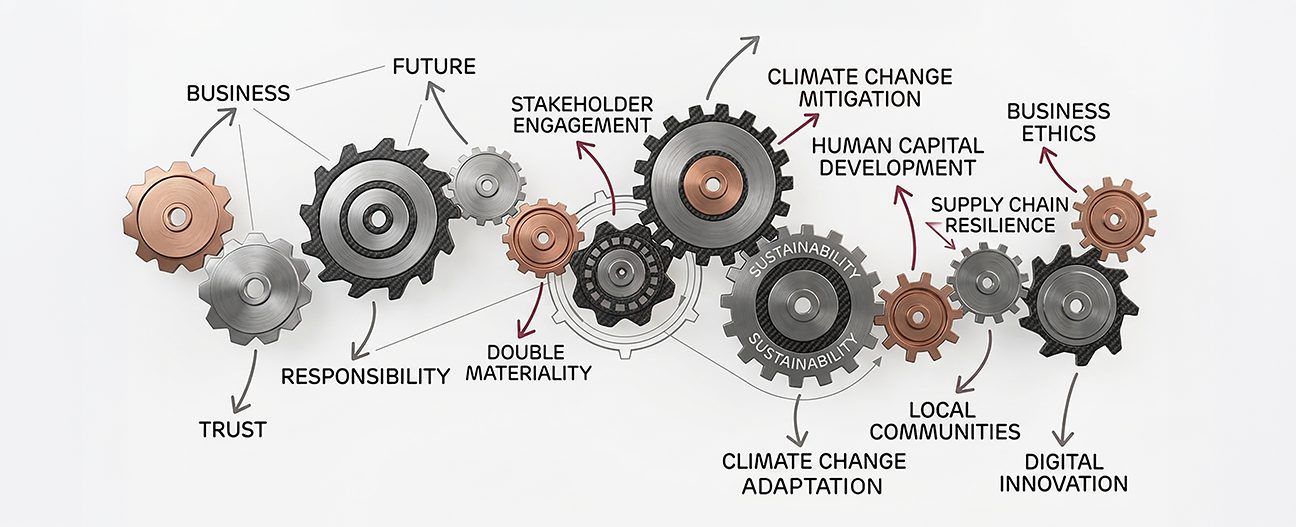
Double Materiality
A sustainability topic is considered material if it meets the criteria of impact materiality, financial materiality, or both.

Impact materiality
Sustainability matters, which “pertain to the undertaking’s material actual or potential positive or negative impacts on people or the environment over the short-, medium- or long-term.” (including products, services and business relationships). This indicates the Company’s contribution to sustainable development.
Considering scale, scope, irremediability and likelihood of impacts.
Financial materiality
Uncertain (environmental, social or governance) events or conditions, which “have a material negative influence or could reasonably be expected to have a material negative influence on the undertaking’s development, financial position, financial performance, cash flows, access to finance or cost of capital over the short-, medium- or long-term”.
Uncertain (environmental, social or governance) events or conditions, which “have a material positive influence or could reasonably be expected to have a material positive influence on the undertaking’s development, financial position, financial performance, cash flows, access to finance or cost of capital over the short-, medium- or long-term”.
Considering magnitude of financial effect and likelihood.
Approach to Materiality Assessment
Our first Double Materiality Assessment commenced in FY 2023-24. The exercise revisited material topics through structured internal engagements and rigorous evaluation, culminating in the identification of 16 priority issues for the business and its stakeholders for FY 2025-26.

Key Factors

Megatrends
- Climate change
- Transition to clean energy
- Diversity, equity & inclusion
- Technology trends in the power industry
- Business model transition
- Digital transformation & innovation
- Geopolitical and geoeconomic forces
- Cybersecurity
- Regulations
- Transforming consumer & societal behaviour and preferences
Prioritising the Material Topics

Environment
- M1 Biodiversity and Habitat Management
- M2 GHG Emissions & Climate Change
- M3 End Use Efficiency and Demand
- M4 Water and Effluent Management
- M20 Waste Management
Social
- M5 Occupational Health & Safety
- M6 Customer Relationship Management
- M7 Employee Engagement
- M8 Diversity, Equity and Inclusion
- M9 Energy Access & Affordability
- M10 Human Capital Development
- M11 Community Relations
- M19 Labour Practices & Human Rights
Governance
- M12 Business Ethics and Transparency
- M13 Supply Chain Management
- M14 Economic Performance
- M15 Public Policy & Advocacy
- M16 Grid Resiliency
- M17 Digitisation, Data Privacy & Information Security
- M18 Product Quality & Safety