Foundations of Sustainable Growth


At Adani Energy Solutions, our vision is to lead India’s responsible energy transition and accelerate the decarbonisation of society by delivering affordable, reliable, and clean energy.
Sustainability is embedded into every aspect of our business, from infrastructure planning and energy distribution to corporate governance and stakeholder engagement.
Our ESG approach integrates environmental considerations, social inclusion, and sound governance into decision-making, enabling long-term value creation, effective risk management, and meaningful contributions to stakeholders, communities and the broader ecosystem.
Our ESG Ambition
To be among the top 10 percentile companies in the global ESG benchmarking of the electric utility sector by FY 2029-30.
Global Leadership
Adani Energy Solutions participates in sector collaborations that support renewable integration and grid development, including being India’s first electric utility company to join IRENA’s Utilities for Net Zero Alliance [UNEZA]. With the divestment of our sole thermal asset at Dahanu in FY 2024-25, we remain committed to no new thermal capacity addition in future.
Key portfolio changes affecting the reporting boundary are described on Pg. 431.

Message from the CSO
At Adani Energy Solutions, sustainability is integrated into our strategy, governance and operational decision-making. This report articulates our approach to identification and management of the material impacts, risks and opportunities, ESG oversight from the Board and management, and performance monitoring mechanism against defined KPIs and targets. A detailed Double Materiality and Stakeholder engagement is the foundation of our ESG strategy, with the relevant disclosures provided on pages 62-67 and cross-referenced in the GRI Content Index. Improved ESG ratings/score during the year reflect the maturity and effectiveness of our sustainability initiatives.
Our ESG Framework
Guiding Principles and Disclosure Standards
















Robust Governance
Double Materiality Assessment
Read more Pg. 64Robust stakeholder engagement plan
Read more Pg. 62Policy advocacy for climate change and renewable energy at national and global levels
Read more Pg. 319Best-in-Class Management Systems

We also follow ISO 46001:2019 - Water Efficiency Management Systems
Aligning with UNSDGs
The ESG pillars and priorities presented below reflect Adani Energy Solutions’ material topics identified through a double materiality assessment conducted in line with GRI 3. The complete list of material topics and assessment methodology is disclosed in this Report.

SDG Targets
SDG 7.a, 7.c, 7.1 and 7.2, SDG 9.4, SDG 13.2, 13.3
Decarbonisation of Operations
- Net Zero 2050 pledge with interim milestones to reduce GHG emissions and renewable energy integration
Decarbonisation for Customers
- Promoting clean energy solutions and enabling our customers to achieve their decarbonisation goals
- In progress: HVDC Transmission link for uninterrupted renewable power supply to Mumbai with commitment of USD 1 billion
SDG Targets
SDGs 6.3, 6.4, 6.5 and 6.6, SDG 12.2, 12.4, SDG 13.1, SDG 15.1
Circular Economy
- Goals for water positive, single-use-plastic-free operations and waste diversion from landfill
SDG Targets
SDG 6.6, SDG 14.1, SDG 15.1, 15.5, 15.9
Biodiversity
- Aiming for No Net-Loss to Biodiversity and Net Positive Gain (NPG) in line with IBBI 2.0 principles


SDG Targets
SDG 16.6, 16.7
Climate Policy Advocacy
- Influencing regulatory landscape for energy transition and innovation through government and industry engagement



SDG Targets
SDG 3.8, 3.9, SDG 4.3, 4.4, SDG 5.5, SDG 8.2, 8.5, 8.8, SDG 9.4, SDG 10.2, 10.3, SDG 13.1, 13.2, SDG 17.9, 17.17
Caring for People
- Fostering Zero Harm and safety culture for employees and contract workers
- Promoting women participation in the workforce and management roles
- Learning and development opportunities
SDG Targets
SDG 6.3, SDG 8.4, SDG 12.2, 12.5 SDG 13.1, SDG 15.1
Prioritising Responsible Supply Chain Operations
- Closely working with suppliers to build their capabilities for responsible sourcing
SDG Targets
SDG 7.2, 7.3, 7.a, 7.b, SDG 9.c, SDG 12.8
Empowering Customers
- Offering uninterrupted and clean energy to decarbonise the consumer households
- Giving customers greater control over energy efficiency management

SDG Targets
SDG 1.4, SDG 3.8, 3.c, SDG 4.1, 4.a, SDG 5.a, 5.b, SDG 8.5, SDG 11.3, SDG 17.17
Empowering Communities
- Improving learning outcomes in the primary schools
- Promoting economic empowerment, especially for women, through sustainable livelihood initiatives
- Improving healthcare access for the last-mile communities
- Strengthening community infrastructure
SDG Targets
SDG 3.9, SDG 4.4, 4.7, SDG 5.1, 5.5, SDG 8.5, 8.7, 8.8, SDG 9.1, 9.4, 9.5, 9.c, SDG 10.2, 10.3, SDG 12.6, SDG 13.1, 13.2, 13.3, SDG 16.5, 16.6, 16.7, 16.10, SDG 17.1, 17.16, 17.17
Strong Corporate and ESG Governance
- Robust oversight, policies and practices to embed vision, mission, policies and strategies at all levels in the organisation, strengthening our enterprise risk and opportunity management for sustained economic value creation
SDGs shown here represent areas of contribution; the primary SDGs are prioritised under the performance sections.
The SDG alignment highlights intended contributions. Adani Energy Solutions’ management approach for material topics policies, actions, resources, grievance/remediation mechanisms, and evaluation of effectiveness is disclosed in the relevant topic sections and mapped to GRI 3-3 and applicable Topic Standards in the GRI Content Index
Remuneration linked to ESG and Climate Performance
At Adani Energy Solutions Limited, climate and ESG performance are directly linked to leadership and employees’ accountability through a performance-linked remuneration framework. Sustainability-aligned Key Result Areas (KRAs) ensure that key management personnel drive measurable progress on climate objectives and responsible business practices.
of the CEO’s compensation is linked to the ESG outcomes
Governance and Oversight
The MD and CEO review the sustainability performance, ESG ratings, draft regulations and KPIs reported in the public domain twice each quarter. Written updates are shared with the Board every month, with quarterly reviews in CRC meetings.
The Integrated Report, including ESG disclosures, are reviewed and approved by the Board of Directors.
Management KRAs and Incentives
CEO KRAs
Implementation of the climate transition plan and achievement of key decarbonisation targets, such as increasing renewable energy procurement, reducing energy intensity per EBITDA, improving water performance, and improving ESG risk ratings.
Senior Management
The Chief Sustainability Officer, Chief Purchase Officer, and Managing Director are incentivised through performance-based metrics tied to climate and sustainability goals.
Operational Integration
- Relevant ESG targets are incorporated into annual performance evaluations of the Business Unit Managers, which include reducing GHG intensity and expanding the renewable energy share
- ESG Champions and the ESG Core Working Group closely track the performance metrics
Our ESG Ratings by Non-SEBI Registered ERP’s
External ESG ratings are third-party assessments with varied methodologies, making them difficult to compare across providers or years. Unless noted otherwise, the ratings refer to Adani Energy Solutions during each provider’s assessment period.
| ESG Rating Providers | FY 2020-21* | FY 2021-22* | FY 2022-23* | FY 2023-24 | FY 2024-25 |
|---|---|---|---|---|---|
CDP Climate Change |
D | D | B | B | B |
| CDP Water Security |
Did not participate | Did not participate | B | A- | A- |
| CDP Supplier Engagement Assessment (SEA) |
-C | B | B | A | A |
S&P Global CSA with MSA |
63 | 59 | 62 | 73 | 81 |
| S&P Global CSA without MSA |
63 | 63 | 68.5 | 80.8 | 90.24 |
Financial Times Stock Exchange (FTSE) Russell |
3.1 | 3.3 | 4.0 | 4.4 | 4.4 |
CSR HUB |
80 | 83 | 86 | 88 | 92 |
SUSTAINALYTICS |
26.8 | 35.3 | 32.8 | 27.9 | 19.5 (Low Risk) |
Morgan Stanley Capital International |
BBB | BBB | BBB | BB | BBB |
Institutional Shareholder Services |
Not evaluated | Not evaluated | Not evaluated | Not evaluated | B- Prime |
Performance Against ESG Goals
| KPIs and Targets | Baseline | Performance in FY 2024-25 | Performance in FY 2025-26 |
|---|---|---|---|
| Energy and Emissions | |||
| Increase Renewable Energy (RE) share in power procurement to: 60% by FY 2026-27; 70% by FY 2029-30 | 2.87% (FY 2018-19) | 35.2% | 37.53% (without REC’s) 65.92% (with REC’s) |
| 100% auxiliary consumption through renewable sources by FY 2029-30 | 3% in FY 2019-20 (1.7 MWp in-house solar capacity) | 42.33% with in-house solar capacity + Green Tariffs | 60.5% |
| 72.7% reduction in Scope 1 & 2 GHG emissions by FY 2030-31 (w.r.t. baseline) | Zero in FY 2019-20 | 45.1% | 86% |
| 27.5% reduction in Scope 3 GHG emissions by FY 2031-32 (w.r.t. baseline) | Zero in FY 2020-21 | 42% | 72% |
| Reduction in GHG emission intensity (Scope 1+2) for AEML (Retail division of the Company), by 40% by FY 2024-25; 50% by FY 2026-27 and 60% by FY 2028-29 | 2,254 tCO2e/EBITDA in FY 2018-19 | 69.7% (683 tCO2e/EBITDA) | 91.26% (197 tCO2e/EBITDA without REC’s) |
| Reduction in energy intensity - 50% by FY 2026-27, and 70% by FY 2029-30 | 481.30 GJ/million ₹ revenue in FY 2019-20 | 82.8% (82.87 GJ/million ₹ revenue) | 97.8% (10.82 GJ/million ₹ revenue) |
| Water and Waste | |||
| Water Positive Certification | Not Certified in FY 2019-20 | 100% for all operational sites collectively Certified | 100% for all operational sites collectively Certified |
| 100% Zero Waste to Landfill (ZWL) Certified Sites | Zero in FY 2019-20 | 100% for all operational sites | 100% for all operational sites |
| 100% Single Use Plastic (SuP) Free Sites | Zero in FY 2019-20 | 100% for all operational sites | 100% for all operational sites |
| Biodiversity | |||
| Area covered under compensatory afforestation to achieve No Net Loss, aiming for Net Positive Gain (NPG) in accordance with IBBI principles | 289 ha in FY 2020-21 | Over 1,198 ha | 888 ha (post 851 ha reduction post divestment of ADTPS w.e.f. Sept 2024) |
| Plant 6.24 million trees by FY 2029-30 | 20,448 trees planted in FY 2021-22 | 6,24,000 trees Planted | 1.6 Lakh trees planted |
| KPIs and Targets | Baseline | Performance in FY 2024-25 | Performance in FY 2025-26 |
|---|---|---|---|
| People and Health & Safety | |||
| Zero Harm across operations | Zero in FY 2020-21 | No employee fatalities reported during the reporting period | No employee fatalities reported during the reporting period |
| Zero fatality rate due to work-related injury for employees and contract workers (per million hours worked) | Zero in FY 2020-21 | 1 (Contract worker) | 2 (Contract workers) |
| Zero Recordable Work-Related Injury Rate for employees and contract workers (per million hours worked) | 0.33 in FY 2020-21 | 0.01 | 0.24 |
| Improve average health & safety training hours per person w.r.t. the baseline | 15.6 in FY 2020-21 | 13.75 | 27.5 |
| Invest on employee upskilling and development | ₹3.81 crore in FY 2020-21 | ₹ 4.99 crore | ₹ 0.73 crore |
| 6% women in the workforce by FY 2025-26 | 5% in FY 2020-21 | 8.6% | 4.4% |
| 30% women in new hires by FY 2025-26 | 5% in FY 2020-21 | 7% | 3.7% |
| Women in Management roles | 7% in FY 2020-21 | 13% | 12% |
| 100% mapping & disclosure of regional & ethnic diversity of employees | No mapping | 100% mapped | 100% mapped |
| Human Rights | |||
| 100% business and partners to be covered under human rights due diligence | - | 100% Operational sites & 100% New suppliers on-boarded are covered | 100% Operational sites & 100% New suppliers on-boarded are covered |
| 100% coverage of Directors and employees on Human Rights training | - | 100% | 100% |
| Freedom of Association and Collective Bargaining | 100% | 100% | 100% |
| Zero cases of human rights violations | Zero | Zero reported | Zero reported |
| Responsible Supply Chain | |||
| Maintain baseline performance for procurement spend on local suppliers (%) | 99.4% in FY 2020-21 | 98% | 99% |
| 100% critical suppliers to be screened using ESG criteria | 100% for critical new suppliers in FY 2020-21 | 100% all-new suppliers screened and critical suppliers assessed | 100% all-new suppliers screened and critical suppliers assessed |
| 100% suppliers to be covered under supplier due diligence by 2030 | Only limited number of suppliers covered until FY 2024-25 | ESG due diligence initiated for all suppliers | ~73% by spends value evaluated |
| KPIs and Targets | Baseline | Performance in FY 2024-25 | Performance in FY 2025-26 |
|---|---|---|---|
| Board Diversity and Independence | |||
| ≥30% Women Directors on the Board | 16.6% in FY 2020-21 | 29% (2/7) | 25% (2/8) |
| ≥50% Independent Directors on the Board | 50% in FY 2020-21 | 57% (4/7) | 50% (4/8) |
| Ethics, Integrity and Compliance | |||
| 100% coverage of Directors and employees under Code of Business Ethics & Conduct | 100% | 100% | 100% |
| 100% of the governance body members and employees trained on anti-corruption | 100% | 100% | 100% |
| Zero cases related to breach of Code of Conduct, including corruption & bribery and anti-competitive practices | Zero | Zero | Zero |
| 100% compliance with applicable legal, environmental, and statutory requirements | - | No material non-compliances identified during the reporting period | No material non-compliances identified during the reporting period |
Awards and Recognitions in FY 2025-26
- Adani Energy Solutions’ smart metering business was Runners-Up in the Ramkrishna Bajaj National Quality Award (Services Category) for its AI-ML powered tool, which automates meter validation and speeds activation
- AEML won the SAP ACE Special Jury Recognition Award 2025 in The Disruptor Customer Experience Management category, reaffirming our commitment to digital innovation and seamless customer engagement
- AEML retained Top Rank in India Utility Ratings for Second Successive Year, Distribution Utilities Ranking (DUR) and Consumer Service Rating of DISCOMs (CSRD), released by the Union Ministry of Power in association with REC Limited
- Adani Electricity won the Golden Peacock National Award for Corporate Social Responsibility 2025
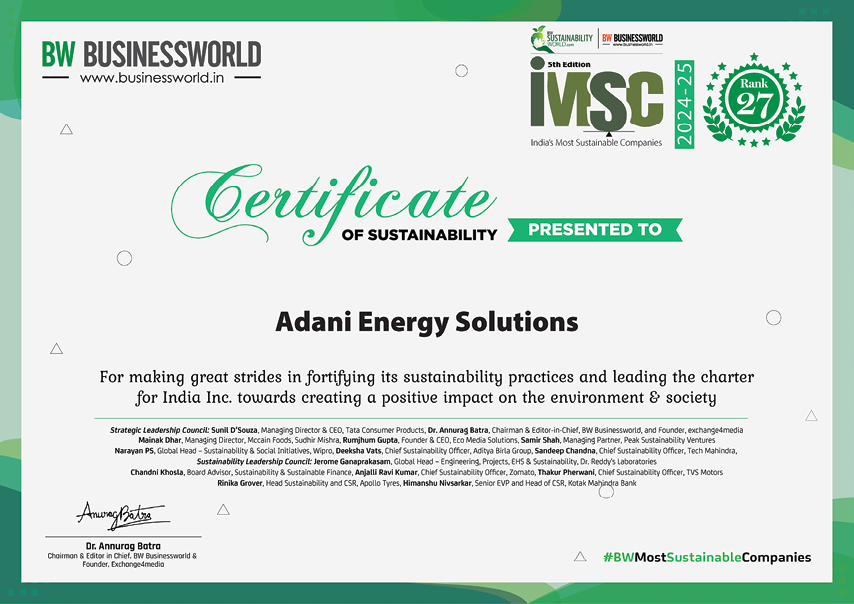
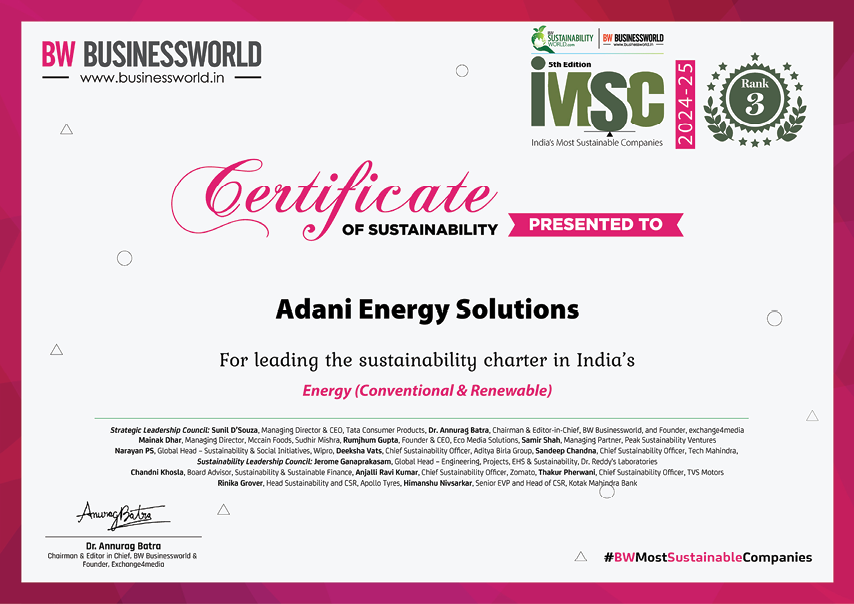
- Adani Energy Solutions recognised as 27th Most sustainable company in India by Business World for FY 2024-25 and 3rd Best among Energy [Conventional & Renewable Energy] sector from top 500 companies by market capitalisation